AI-Driven Development: The Complete Method
The complete guide to AI-Driven Development (ADD): the method where AI writes the code and you own direction and verification — the five competencies, the eight-step loop, the frozen contract, tests-first agent builds, evidence-based verify, and a real production case study.
In this series
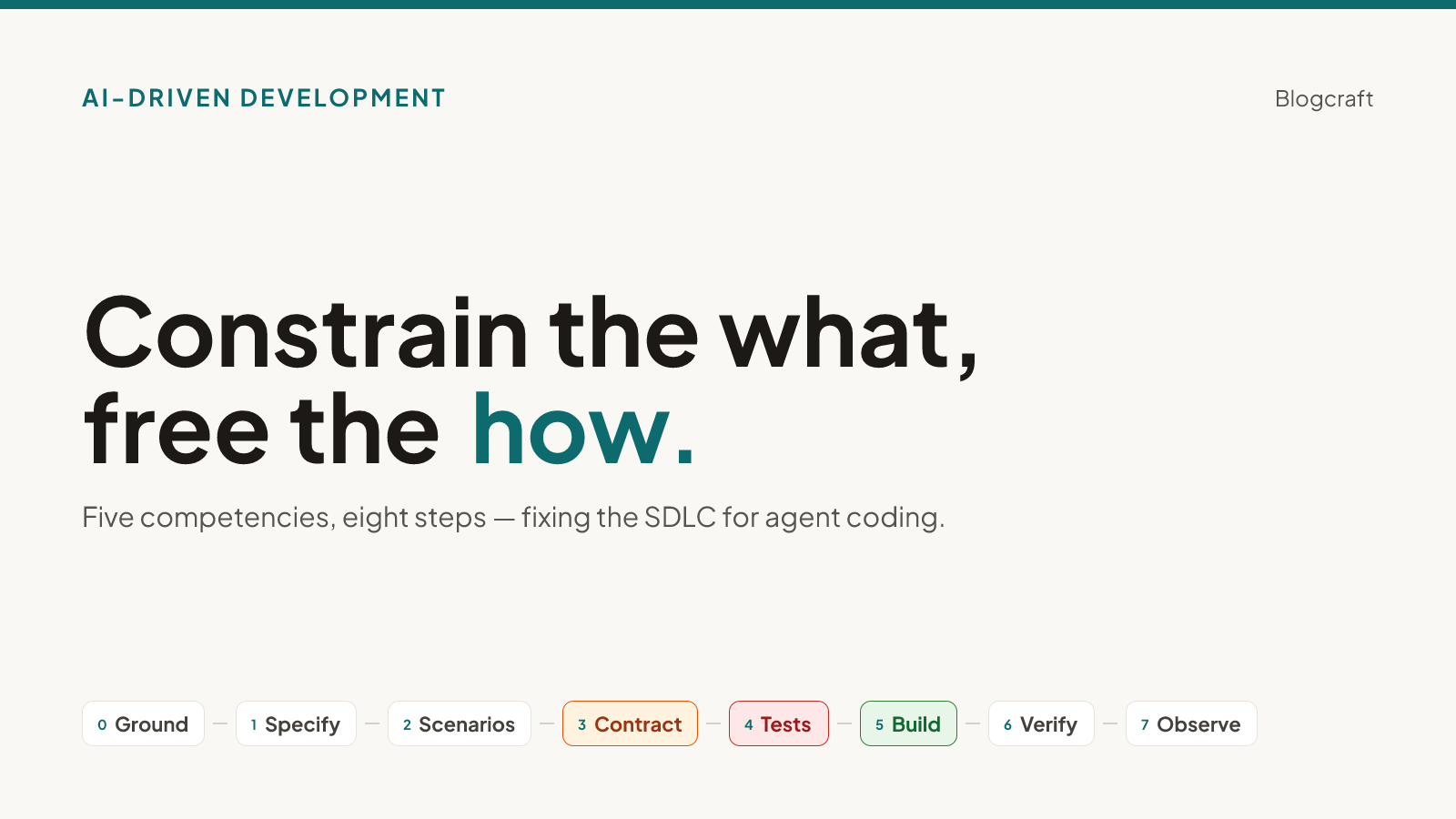
- 1 How AI-Driven Development Fixes the SDLC for Agent Coding 26 min read
AI made writing code nearly free and quietly broke the SDLC. AI-Driven Development — five competencies, eight steps — constrains what an agent builds while freeing how it builds, proven across a 23-milestone production gateway shipped in six days.
- 2 The Five Competencies of AI-Driven Development 12 min read
The five competencies behind AI-Driven Development — Domain, Spec, UI/UX, Test, and AI/Build — and why each is a separate discipline the agent stands on. The foundation that makes 'constrain the what, free the how' actually work.
- 3 Specify and Scenarios: Killing Fast Waste Before It Starts 11 min read
ADD's first two steps kill fast waste before a line of code exists: Specify (Must do, must Reject with error codes, the After-state) and Scenarios (concrete happy, edge, and failure examples in domain language). Pin the what.
- 4 The Frozen Contract: ADD's One Human Gate 12 min read
The frozen contract is ADD's one human gate — the interface, data shapes, and error codes, locked and checksummed before the agent builds. Why it is the single approval that earns the agent its autonomy.
- 5 Red Tests and the Build Loop: Tests-First for AI Agents 11 min read
Tests-first, pointed at an AI agent: write a red suite that asserts observable behavior, then turn the agent loose with one instruction — make every test pass, change nothing in the tests or the contract. Red to green.
- 6 Verify by Evidence: ADD's Earned-Green Refute-Read 13 min read
Verify by evidence, not by reading the diff. ADD's earned-green: an adversarial refute-read that tries to break the result, because AI code is frequently plausible and wrong. Trust through proof.
- 7 Observe and Fold: How ADD Improves Itself 11 min read
The step that closes the loop: Observe production behavior and fold the spec delta back into the next Specify. How ADD keeps documents living while old-school artifacts rot — and how the method improves itself.
- 8 ADD in Production: The ai-proxy Field Study 12 min read
A field study of ai-proxy, a multi-tenant AI gateway built end-to-end with ADD: 23 milestones, ~120 tasks, six days, zero waivers. What the method felt like in production and how the LLM behaved when scope was clamped.
- 9 Where ADD Sits: Lineage, spec-kit, and GSD 13 min read
Where ADD sits among its neighbors: the lineage it inherits from TDD, DDD, BDD, and contract-first design, and how it differs from spec-kit and GSD by continuing past Verify to Observe and folding the loop closed.
- 10 Measuring ADD Across the SDLC: What ai-proxy Cost, by Phase and by Role 27 min read
A data-driven companion to the ai-proxy field study. Mining the transcripts and the .add foundation to measure an AI-driven build across the full SDLC and every role, against modeled human baselines of 6 person-months to 32 person-years, with the caveats that keep the comparison honest.
- 11 Why ADD Spends Fewer Tokens Than GSD — Without Getting Less Safe 14 min read
A controlled comparison: two AI workflows build the same forty-line function from one spec. GSD records it in five files and 644 lines of prose; ADD in a 22-line contract. Real recovered artifacts and exact token logs show ADD spent 5× fewer tokens with the same passing tests.
- 12 Normal AI Use vs Pro AI Use: The Same Feature, Built Two Ways 11 min read
Same AI, same codebase, same money-critical feature — built two ways. An apples-to-apples walk through 'normal' AI coding versus pro AI-Driven Development on a real billing-reconciliation milestone, with the tests, gates, and numbers that separate hope from proof.
- 13 From Enterprise SDLC to Solo Vibe-Code with ADD 16 min read
You left the enterprise SDLC — change boards, QA gates, sign-offs — to vibe-code solo with an AI. The safeguards didn't have to follow you, but their jobs did. A field guide mapping each one to its lean ADD equivalent, grounded in two real solo projects.